Temperature & Optics
Types of Thermometers: Contact vs. Non-Contact
Updated 2026-06-13 · Hotech Technical Team
In short
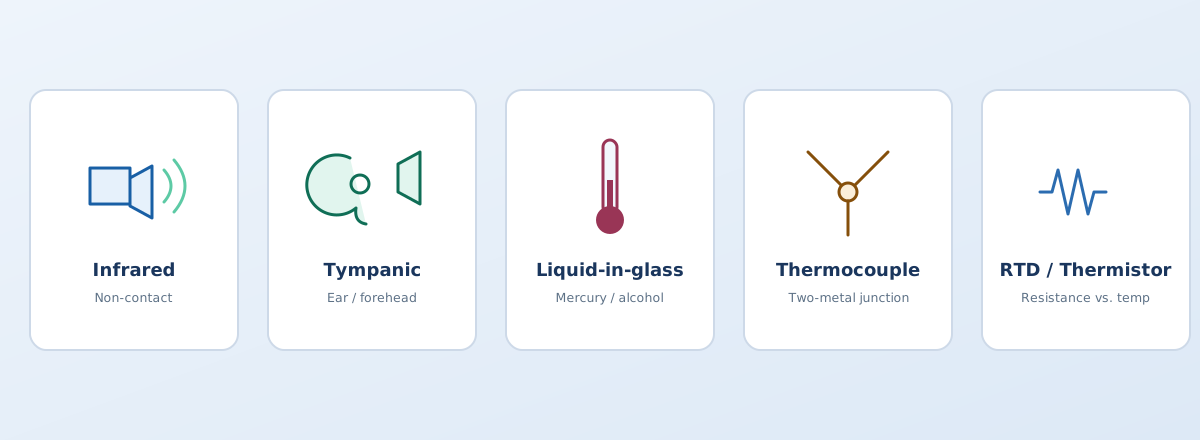
Thermometers fall into two categories by principle: contact (thermocouples, RTDs, thermistors, liquid-in-glass) which touch the object, and non-contact (infrared thermometers, thermal imagers) which infer temperature from emitted infrared radiation.
Contact thermometers
- Thermocouple: wide range, high-temperature, fast response; common in industry.
- RTD / Pt100: high accuracy and long-term stability; used for precision measurement and standards.
- Thermistor: highly sensitive, good for precise measurement over narrow ranges.
- Liquid-in-glass and bimetallic: simple, power-free traditional options.
Non-contact thermometers
- Infrared thermometers (ear/forehead/industrial): fast and non-contact, suited to people and moving/hot objects.
- Non-contact measurement is affected by emissivity and distance, and requires periodic calibration with a blackbody source.
Choosing and calibrating
- Choose by range, accuracy, whether contact is possible, and response speed; all thermometers need periodic calibration.
Related Products
- Ear/Forehead Thermometer Calibrator 336 →
- Calibration Bath 636 →
- Low-Temperature Incubator / Calibration 621 →
FAQ
Contact vs. non-contact — what's the difference?
Contact types touch the object and are usually more accurate; non-contact types measure infrared radiation — fast and touch-free but affected by emissivity and distance.
Which thermometer is most accurate?
RTD/Pt100 is common for high-precision measurement and standards due to stability and accuracy; it still depends on use case and regular calibration.
Do thermometers need calibration?
Yes. Any thermometer drifts over time, so establish a regular calibration program for accuracy and traceability.