Selection Guide
How to Choose a Blackbody Source: Five Key Criteria
Updated 2026-06-13 · Hotech Technical Team
In short
Choosing a blackbody source depends mainly on the instrument type and temperature range: ear/forehead thermometer calibration needs a 32–42°C medical blackbody; industrial pyrometers need a high-temperature furnace. Also consider effective emissivity, uniformity and stability, aperture size (must exceed the instrument's field of view) and a traceability certificate.
Confirm use and range
- Medical thermometer calibration centers on 32–42°C; industrial pyrometers need higher ranges; some applications are low-temperature.
Five key specifications
- Temperature range: must cover the instrument's measurement points.
- Effective emissivity: the closer to 1, the better.
- Uniformity and stability: affect calibration reliability.
- Aperture: must be larger than the instrument's field of view (FOV).
- Heating/cooling speed and traceability certificate: affect efficiency and traceability.
Hotech models
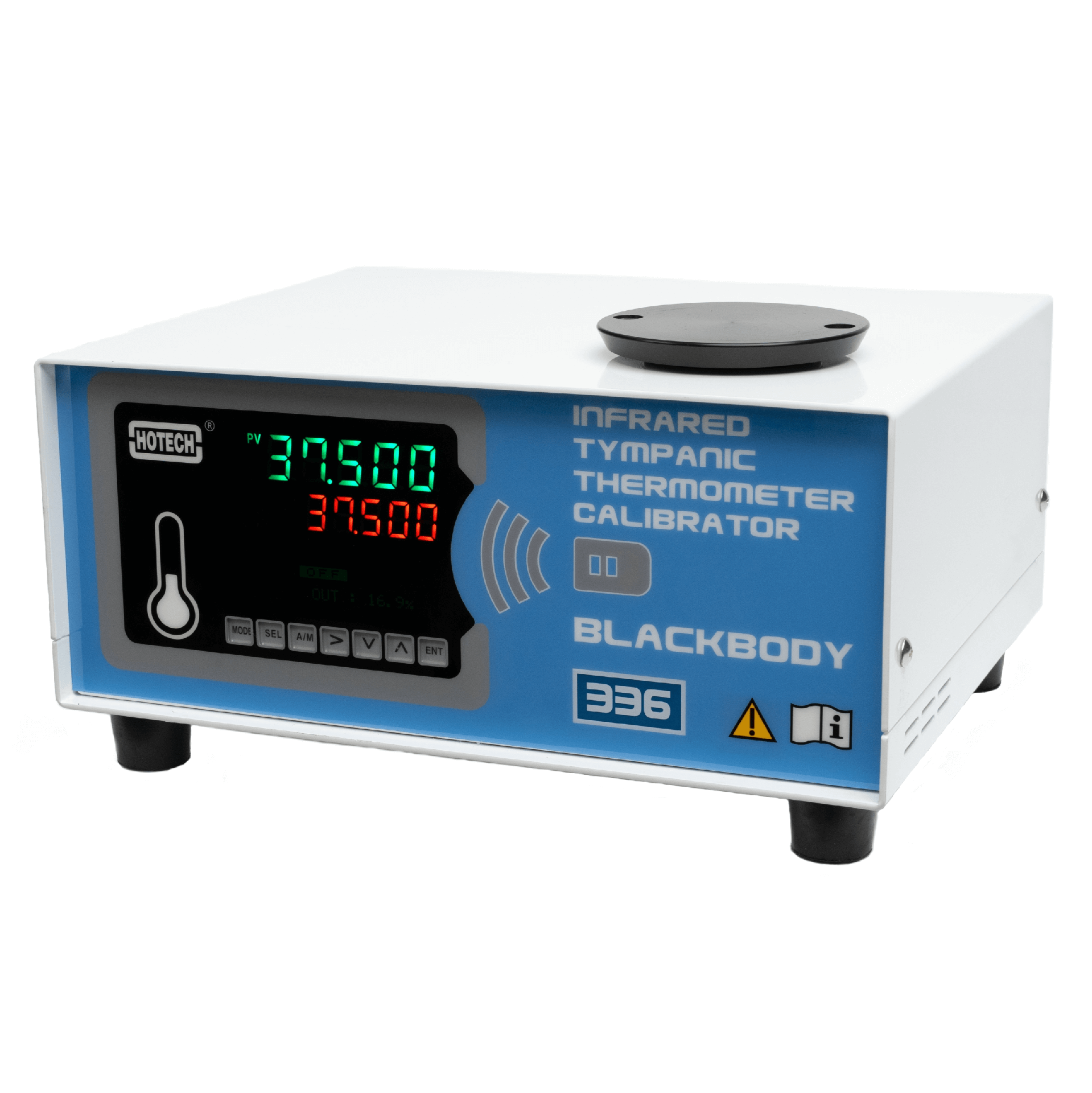
- Ear/forehead: 320, 322, 336; forehead/non-contact: 372, 3721; low-temperature high-uniformity: 360; wide range: 383–392.
Related Products
- Ear/Forehead Thermometer Calibrator 336 →
- Precise Tympanic Calibration Source 322 →
- Non-Contact Infrared Blackbody 372/3721 →
FAQ
Which blackbody for ear thermometers?
Choose a 32–42°C medical blackbody (e.g., 320/322/336) covering human body-temperature points.
Why does aperture size matter?
The aperture must exceed the instrument's field of view, or it will read the blackbody edge and introduce error.
What effective emissivity is enough?
The closer to 1, the better; precision furnaces typically reach about 0.95–0.99.